Recycling and Sustainability ??? Carpet Cleaning Services with a Green Heart
 Our commitment to sustainable carpet cleaning is part of everything we do. As a leading eco-conscious carpet cleaning service, we actively reduce landfill waste, cut transport emissions, and support community reuse schemes. We aim to set an example in the sector by combining professional cleaning standards with measurable environmental goals. This page explains our recycling targets, how we use local transfer stations, our charity partnerships, and the low-carbon vans that keep our operations efficient and clean.
We recognise that modern carpet cleaners must go beyond cleaning rugs and upholstery: they must manage the residual materials responsibly. That means segregating textile offcuts, carpet underlay, worn carpets and packaging on every job, recording volumes, and directing those materials to appropriate circular-economy streams. Where possible we prioritise reuse, followed by mechanical recycling of synthetic fibre and recovery of natural fibres for insulation or composting when appropriate.
 Recycling percentage target: our formal goal is to recycle or divert at least 75% of all operational waste by the end of 2028. This target covers waste generated from site clean-ups, replacement materials, used underlay, and packaging from consumables. We monitor progress quarterly, adjust routes and segregation practices, and publish internal summaries to ensure continuous improvement in our eco carpet cleaning and sustainable carpet cleaning services.
How we use local transfer stations and borough systems
We work closely with local authority transfer facilities and borough waste separation schemes to ensure materials go to the correct next stage in the recycling chain. In areas where boroughs operate separate streams for glass, paper, food waste, garden waste and textiles, our teams follow the local separation rules so that nothing is misdirected. When textiles and carpets are collected from a job, we transport them to municipal transfer stations, borough collection depots, or specialised textile recyclers depending on the material type.
![A young woman with curly brown hair and a cheerful expression is shown in a bright, modern kitchen, engaging in cleaning activities. She is wearing a colorful floral top, pink trousers, and orange rubber gloves. She is holding a pink cloth in her right hand and is leaning slightly forward, using her left hand to wipe a white washing machine or appliance situated near a large window that allows natural light to fill the room. Behind her, part of a clean, tiled kitchen countertop and a shiny, reflective surface of the appliance are visible. The area appears well-maintained, with smooth, polished surfaces and a tidy arrangement, reflecting a professional approach to residential cleaning in the area near [POSTCODE] or [TOWN]. The scene emphasizes a focus on cleanliness and hygiene, aligning with the services offered by Carpet Cleaning Services on their 'Recycling and Sustainability' page, subtly reinforcing their commitment to environmentally conscious cleaning practices in the UK.](/pub/_photos/cleaning/f1650651536.jpg) We also make use of municipal transfer stations to consolidate and re-route large carpet loads to specialised processors ??? places that accept carpet tiles, broadloom, and underlay. These local transfer facilities are crucial: they reduce double handling, lower carbon transport by enabling return loads, and improve recovery rates because many have direct links to reclaimers who turn synthetic pile into underlay or industrial fibre products.
We also make use of municipal transfer stations to consolidate and re-route large carpet loads to specialised processors ??? places that accept carpet tiles, broadloom, and underlay. These local transfer facilities are crucial: they reduce double handling, lower carbon transport by enabling return loads, and improve recovery rates because many have direct links to reclaimers who turn synthetic pile into underlay or industrial fibre products.
As part of our area-focused approach, our teams are trained on local borough policies. In some boroughs, residents separate textiles and small bulky items for collection; in others, drop-off reuse centres or community reuse pods are common. We map these distinctions and adapt job-level waste segregation to fit the local system ??? a practical detail that improves recycling outcomes citywide.
Partnerships with charities and community reuse programmes
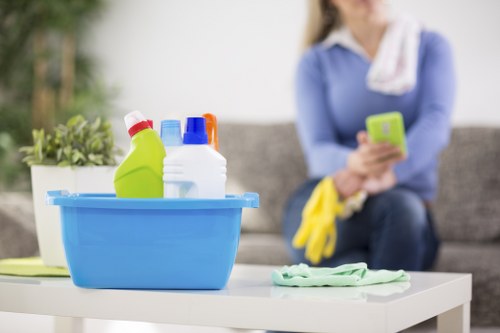 Donating usable rugs, underlay, and reclaimed carpet tiles to charities is central to our approach. We vet partner charities and community reuse organisations that accept cleaned textiles for resale in furniture reuse shops or redistribution to families in need. These partnerships reduce waste, provide social benefit, and extend the life of materials that would otherwise be landfilled. We prioritise donations to local community centres and verified social enterprises over disposal whenever a material is reusable.
Our sustainable carpet cleaning teams also support social procurement: when carpets are removed during commercial contracts, we assess whether sections can be recovered for training projects, community arts, or insulation for local schemes. We maintain a list of approved social partners and rotate distribution so that benefits are spread across boroughs and neighbourhoods. This circular mindset turns waste into resources for people and projects.
![The image shows a modern kitchen area with a stainless steel gas cooktop featuring four burners, embedded in a black countertop surface that appears clean and well-maintained. Above the cooktop, there is a sleek, stainless steel range hood with integrated lighting, mounted on a light-colored tiled wall. The tiles are large, glossy, and beige or cream in colour, providing a smooth and reflective surface that enhances the room’s brightness. To the right of the cooktop, there is a white electrical socket, positioned at an accessible height. Natural light is reflecting off the countertop and tiles, suggesting nearby windows or a source of daylight. The overall scene indicates a tidy and organized kitchen space, aligned with professional cleaning standards, and subtly supporting local context within the UK, particularly in or near [TOWN] or postcode [POSTCODE], which is typical for a location served by Carpet Cleaning Services from carpetcleaningservices.org.uk. The environment appears free of dust, stains, or clutter, exemplifying meticulous cleaning practices suitable for residential or commercial kitchens in the UK.](/pub/_photos/cleaning/theeasywaytocleanagreasyexhausthood02.jpg) Operational steps we take include:
Operational steps we take include:
- On-site segregation: separating textiles, mixed plastics, contaminated materials, and general waste at source.
- Destination routing: delivering separated streams to municipal transfer stations, accredited textile recyclers, or charity partners.
- Material audits: quarterly reviews of volumes sent to landfill versus reused/ recycled.
Beyond recycling, our sustainable carpet cleaners prioritise low-carbon transport. We operate a growing fleet of low-emission vans ??? a mix of battery-electric vehicles and Euro 6 hybrid models ??? and apply route-optimisation software to minimise mileage. Reducing idling and planning multi-job runs in the same borough decreases fuel use and emissions, which is essential for any green carpet cleaning services provider wanting to lead by example.
We also reduce chemical and water usage without compromising cleaning performance. Our technicians use concentrated, biodegradable cleaning agents and high-efficiency extractors that recover and re-use a proportion of rinse water. These choices cut both operational waste and the environmental footprint of each job, contributing to our overall recycling and sustainability goals.
To ensure accountability, we track key performance indicators: percentage of waste diverted from landfill, number of donations to charities, average emissions per job, and proportion of the fleet that is low-carbon. These KPIs inform investment decisions such as increasing EV chargers at depots or expanding charity partnerships in boroughs with high reuse demand.
We know that small actions add up: from consistently separating textile offcuts on-site to choosing low-carbon vans and strengthening local charity networks, every practice helps build a circular economy around carpet care. Our work with municipal transfer stations, borough waste systems, and community partners makes our carpet care and rug cleaning offerings demonstrably more sustainable.
If you are exploring environmentally responsible carpet cleaning or evaluating providers, look for clear recycling targets, transparent destination reporting, and active partnerships with reuse charities ??? all of which we have embedded into our service model. By committing to a 75% diversion rate by 2028 and continuing to invest in low-emission vehicles and local reuse connections, we aim to be a model of best practice in green carpet cleaning services.
Together, we can keep carpets fresh, communities supported, and waste out of landfill.